Systems

One shared record

Priors runs on one character and records database. A ticket, an arrest, a sale or a registered car is written once and shows up everywhere it matters: on the next plate run, in the courtroom, on the character's history. Below is every system in the design, and an honest badge for how far along each one is.

Most of them now have a working backend: the records, rules and screens behind the system, running ahead of the game. You can try them in the playground. The game's own side of each one, the driving, the treating, the 3D world, is still to build.

  • Prototype workingRuns today as a prototype backend
  • DesignedDecided in the design document
  • PlannedIntended, not built yet

The connecting idea

Written once, seen everywhere

On a lot of roleplay servers, the police script, the shop script and the phone script each keep their own notes. In Priors every system reads and writes the same database, so what happens in one corner of the county follows the character into all the others.

Central database Character & records Characters · inventory · vehicles · property · records · NPC identities

Solid: a prototype backend runs todayOutlined: designed, not built yet

Follow one ticket through the county

  1. 01

    The stop

    The deputy runs the plate on the MDT. The return shows the registered owner, licence status, insurance and any warrants.

    Prototype working
  2. 02

    The ticket

    Charges come from the county code. The server adds up the fines and refuses any offence that needs an arrest.

    Prototype working
  3. 03

    The record

    The citation is saved under its number, with the printed and signed ticket attached.

    Prototype working
  4. 04

    The next stop

    Any officer who runs that name later sees the citation among the priors on the return.

    Prototype working
  5. 05

    The court date

    A misdemeanor gets a date 14 days out, or the driver contests the ticket. Player judges, prosecutors and defense attorneys hear the case.

    Prototype working
  6. 06

    Fine or time

    The judge sentences from the county code: the fine becomes a bill at the bank, the jail time a booking that counts down. The verdict goes back on the same record the deputy started.

    Prototype working

Steps 1 to 4 are what the CAD prototype does today; steps 5 and 6 run on the courthouse terminal and the bank, and you can play all six in the playground, with sample records. In the game, the same loop runs on in-game terminals. That loop is the Phase 1 gate on the roadmap.

The catalogue

Every system, with its status

Fifteen systems from the design document. Fourteen have a working backend: the CAD, records and penal code from Phase 1, and the Phase 2 systems built on the same records. Each card says which part is still to build in the game.

DispatchPrototype working

CAD & MDT

The dispatch console and the patrol-car terminal: 911 calls, units, plate and name returns, citations, arrests, warrants and reports. It is the front end of the shared record. In the game it lives only on in-game vehicle and station terminals; today it runs as a browser prototype.

Take the tour
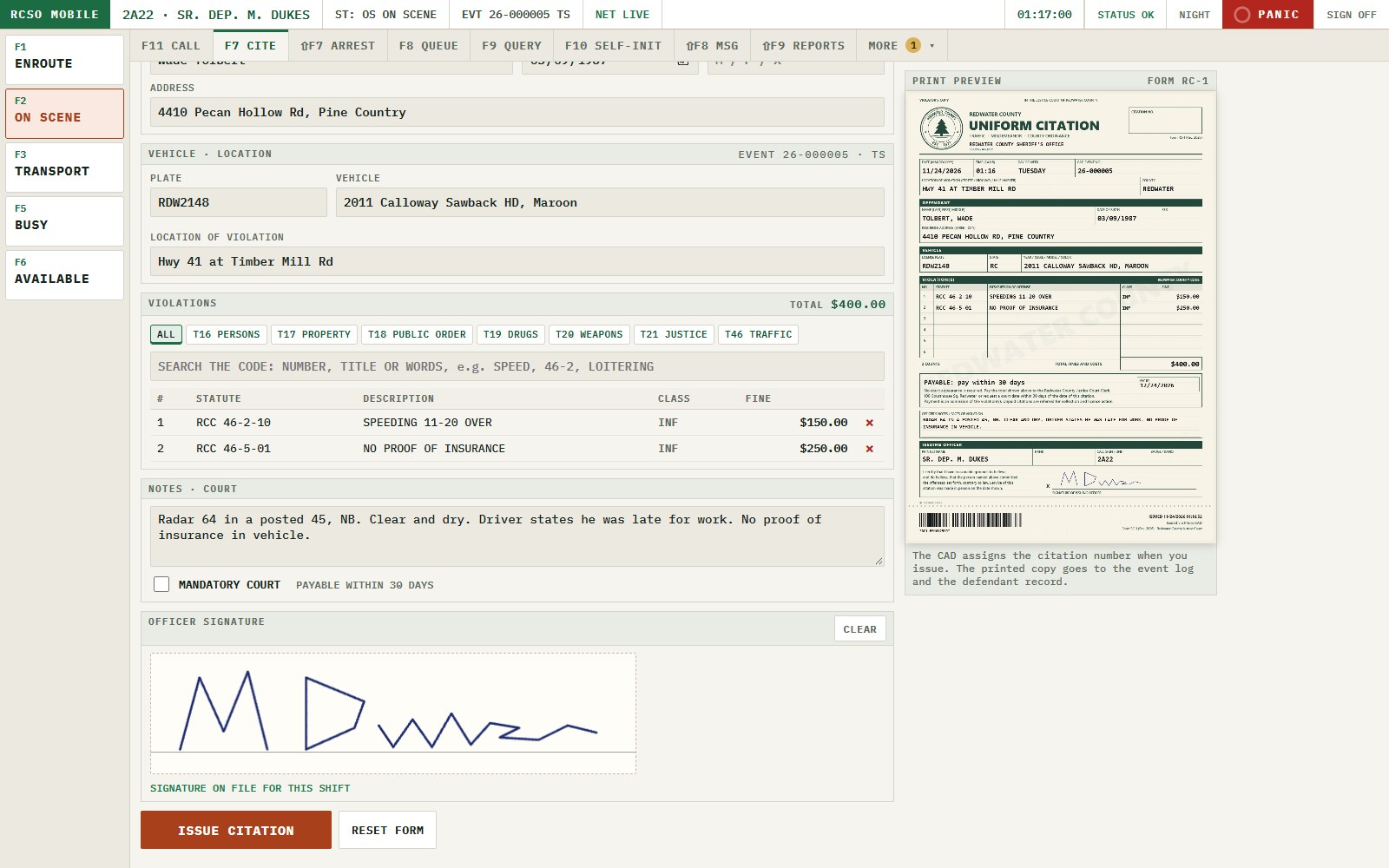
The Priors MDT prototype on its citation screen: two traffic violations totalling $400 with the officer's signature, next to a print preview of the Redwater County uniform citation.
JusticePrototype working

Penal code & citations

The Redwater County Code: 168 offences in seven Titles, each with a class and a standard fine. Charges map to fines and jail time, and server owners can edit the code for their county.

On the record: citations, fines, court dates

Browse the code →
RecordsPrototype working

Records & licences

Driver's licences, vehicle registration, warrants and criminal history. Every plate or name run reads them, and every stop can add to them.

On the record: licences, registrations, warrants, history

What a record holds →
CourtsPrototype workingIn game planned

Courts & jail

Judges, prosecutors and defense attorneys are players, working from the case record. Every arrest books a custody and opens a case; the courthouse terminal handles pleas, verdicts, bail, sentencing, warrants and expungement, and the jail counts the time down.

On the record: cases, hearings, bookings, sentences

How a case gets there →
InvestigationPrototype workingIn game planned

Evidence & forensics

A crime leaves something behind. Deputies collect it with a chain of custody, the crime lab runs the exam, and a print or a casing turns into a name, sometimes weeks later when the suspect is booked.

  • Fingerprints
  • Shell casings
  • DNA
  • Cameras
  • Drugs
From scene to court →
WorldPrototype workingIn game planned

NPC identities

When you deal with an NPC, it gets a persistent identity: a name, a record, a vehicle, maybe a warrant. It can be stopped, cited and arrested, and found again later. The backend issues and keeps them; the NPCs walking and driving the county come with the game.

On the record: NPC names, vehicles, warrants

NPCs in the county →
CrimePrototype workingIn game planned

Crime gating

Bigger crimes need a minimum number of police on duty, counted live from the CAD. A heist doesn't open at 4 a.m. with nobody to answer it. Nine default tiers, from petty theft to a heist, each with a cooldown; every server can change the numbers.

The tiers →
MedicalPrototype workingIn game planned

Injury & hospital

Three layers a server picks: downed with a bleed-out timer, injuries by body part with treatment steps, and permadeath only by the server's rule. Medics write the ePCR; Redwater General admits, treats and bills.

On the record: ePCRs, admissions, death records

The three layers →
EconomyPrototype workingIn game planned

Hybrid economy

The server sets base wages and prices. Player businesses stock products and set their own prices on top. Every dollar moves through a double-entry ledger at a fictional county bank, so fines, rent, wages and sales all add up.

On the record: accounts, sales, bills, payroll

The two layers →
VehiclesPrototype workingDriving planned

Sim-level vehicles

Fuel, mileage and damage by part, saved per car. Titles, insurance and claims, the impound lot, and repair jobs a mechanic quotes and fixes. The handling itself comes with the game.

On the record: vehicles, titles, policies, repairs

What's simulated →
HousingPrototype workingInteriors planned

Homes & apartments

Buy or rent a real parcel on the map, or lease a unit behind a shared front door. Deeds, leases, rent, keys and the doors they open are all on the record.

On the record: deeds, leases, keys

Two kinds of home →
ProgressionPrototype workingIn game planned

Skills & certifications

Thirteen skills that improve with use, up to a cap each server sets. Written exams for permits and licences, from hunting to piloting, and the licence goes on the record when you pass.

How it works →
CommunicationPhone workingVoice planned

Voice, radio & phone

Proximity voice and radio built into the game, with department and private frequencies. The phone's backend already runs: numbers, texts, call logs, 911 to the dispatch board, two county apps and the radio channel plan.

Three channels →
WorldPrototype workingIn game planned

Weather & seasons

A server clock with its own speed, Gulf-coast weather drawn every three in-game hours from monthly tables, the four seasons, and emergencies a server declares: hurricanes, floods, power outages by beat.

The living world →
CharactersDesigned

Character creator

Detailed sliders for face, body, hair and tattoos. Each server decides how many characters a player can have.

On the record: characters

More on characters →

Try it in the playground

Every working system, in a county of your own

The playground gives you a private, temporary Redwater County in your browser with all of these backends connected: take the dispatcher's seat, sentence a case, write an ePCR, rent a flat, run a ballistics exam or change the weather. Fictional data, a browser preview rather than the game, and it resets when you leave.

Justice

The Redwater County Code

The default county ships with its own fictional penal code. It is the same table the CAD prototype uses: the MDT picks charges from it, the server computes the fines from it, and the printed ticket quotes it. Server owners can edit it for their own county.

Code, citations, courts and jail workingCourtroom and cells in game planned

Seven classes, from a parking ticket to a felony

Class Offences Standard fine What happens
INF Infraction 39 $25 to $300 Payable within 30 days
M-C Misdemeanor C 22 $150 to $750 Court date; up to 30 days
M-B Misdemeanor B 22 $300 to $900 Court date; up to 6 months
M-A Misdemeanor A 22 $500 to $1,500 Court date; up to 1 year. DUI and a few others are arrest only
F-3 Felony 3rd 34 $1,500 to $5,000 Arrest only; 1 to 5 years
F-2 Felony 2nd 16 $5,000 to $10,000 Arrest only; 2 to 10 years
F-1 Felony 1st 13 $15,000 to $50,000 Arrest only; 5 to 30 years, some longer

Jail terms are the code's default sentencing guidance for the court; some offences carry their own. Every felony is arrest only, so the MDT greys it out on a ticket and the server refuses it.

Browse the Redwater County Code (168 offences)

    The fictional code of the default county, in seven Titles. Infractions are payable within 30 days. Misdemeanors (classes C, B, A) and flagged infractions need a court date. Felonies and a few serious misdemeanors, such as DUI and domestic battery, are arrest only: the MDT greys them out on a ticket.

    From the scene to the courtroom

    1. Investigate Evidence

      Fingerprints, shell casings, DNA and camera footage go to the crime lab, and a match ties the crime to a name.

      Prototype working
    2. Charge Citation or arrest

      Charges from the code. A citation gets a court date 14 days out when it needs one; an arrest is booked into the county jail and opens a case with an arraignment.

      Prototype working
    3. Decide Player-run court

      A judge, a prosecutor and a defense attorney, all players, work from the case record: pleas and verdicts charge by charge, filings, hearings and bail.

      Prototype working
    4. Sentence Fine or jail

      The fine becomes a bill; the jail time counts down at the county jail by the courthouse, or the state prison in pine country for long sentences.

      Prototype working

    Records & licences

    What a record holds

    A plate or name run is only as good as what's behind it. These are the records the CAD prototype keeps today, and the ones the game adds.

    Record What's on it Status
    Driver's licence Valid, suspended, revoked or none, on every name return. A suspended owner shows on the plate run too. Prototype working
    Vehicle registration Plate, year, make, model, colour and registered owner; registration and insurance status; stolen flags. Prototype working
    Warrants Arrest, bench and search warrants. An active one lights up the return as a hit, and can be served with an arrest. Prototype working
    Criminal history Citations and arrest bookings. The ten newest citations come back as priors on every name return. Prototype working
    Field contacts, tows, BOLOs Field interview cards, tows and impounds on the plate, and be-on-the-lookout notices that flag a matching return. Prototype working
    Incident reports Written on the MDT, then approved or sent back by a supervisor. An arrest opens a draft report for the arresting officer. Prototype working
    NPC identities Created the first time a player deals with an NPC, then kept, so the same driver can be found again next week. Prototype working
    Cases, custody, fines owed Open court cases and the next hearing, whether the person is in custody, and unpaid fines, on every name return. Prototype working
    Forensics, permits, property Prints and DNA on file after a booking, permits and licences from the exams, and the addresses a person owns or rents. Prototype working
    Inventory What a character carries and keeps in the trunk or at home, saved in the same central database. Designed

    In the prototype, people and vehicles are sample records. Once the game connects, the game server owns the real ones and the CAD reads them. See the CAD & MDT →

    Try it · DMV counter

    Make a county licence

    Fill in an applicant, pick a portrait, sign, and the counter prints a Redwater County licence, front and back. The number uses the same RC + 7 digit format the DMV backend issues (here it is derived from the name and date of birth, so the card stays the same while you edit), and every card is marked as a sample game item.

    Money, cars, homes

    The everyday systems

    The systems every career leans on, whether you wear a badge or not. Their backends run today: you can open an account, buy a car and lease a flat in the playground. Spending the money, driving the car and walking into the flat come with the game.

    Backends workingIn game planned

    A hybrid economy

    Neither fully scripted nor fully player-run. The server gives the economy a floor; players build on top of it. Fines, rent, hospital bills and repair jobs all arrive as bills at the same bank.

    Layer 2 · Players Player businesses Produce goods and set their own prices
    Layer 1 · The server Base wages and prices Set by each server owner

    Sim-level vehicles

    Cars behave like cars. Long drives on county roads cost fuel, crashes cost parts, and neglect catches up. Six parts are tracked per car (engine, transmission, brakes, tyres, body and lights), and a mechanic's repair job restores them.

    • FuelTanks run dry
    • Damage by partNot one health bar
    • MaintenanceWork for mechanics
    • Realistic handlingWeight and grip

    Two kinds of home

    On the map Real buildings

    Buy or rent a house that stands in the county, on a street anyone can drive down.

    Instanced Apartments

    A private interior behind a shared front door, so one building can house many players.

    By default rent comes out every week; a missed payment brings a notice, and three mean eviction. Your key opens your door and nobody else's.

    Voice & characters

    Who you are and how you talk

    Roleplay is mostly talking. Priors builds voice and radio into the game instead of leaving it to an outside app, and gives every character a face and a skill set of their own.

    Phone and progression backends workingVoice, radio and creator designed

    Proximity voice

    Talk to whoever is near you. Voices fade with distance, the way they would on a real street.

    Radio

    Department frequencies for dispatch and units, private frequencies for everyone else. Range matters. The channel plan and who may join each one already live in the backend.

    Phone

    Calls, texts and apps. Dial 911 and the call lands on the dispatcher's screen. Numbers, messages, call logs and 911 run today in the playground's web phone.

    Try it · The phone

    A phone in your pocket

    This is the earlier concept mock-up, which runs only in this page and carries its own Planned badge: some of its apps (maps, a camera) are ideas still open. Pay a citation, haggle with the garage, or dial 911 and see the call land on a dispatcher's screen. The real phone backend, with texts, calls, 911, the Porchlight feed and Swap Sheet classifieds, is in the playground.

    Progression by doing

    Prototype working

    Skills improve with use, and the bigger steps come through training, certifications, licences and rank, the way they would in the job itself. The backend tracks thirteen skills from driving to piloting, and runs ten-question written exams for permits such as concealed carry, hunting, boating and tow operator.

    Progression in each career →

    Character creator

    Designed
    • Face
    • Body
    • Hair
    • Tattoos

    Detailed sliders for face, body, hair and tattoos. The server sets how many characters each player can keep. Characters and their registered vehicles already save to the prototype's database.

    Injury, death and permadeath →

    Still open

    What isn't decided yet

    Some system questions are still open, and the founding community gets a say in them.

    Weigh in on the roadmap page →
    • OpenThe default crime tiers ask for 0 to 6 officers on duty. Are those the right numbers?
    • OpenDoes the CAD/MDT also need a web version for supervisors or court staff?
    • OpenWhen does permadeath apply, and who decides?
    • OpenLua or JavaScript for the server scripting API?

    Founding community

    Get in before the county opens

    The first players and server owners will shape how this game works. Join now and you'll be there for the design calls, the CAD testing and first in line for the closed alpha.

    • See development builds and devlogs first
    • Vote on the open design questions in Weigh in
    • Apply to bring your RP community into the closed alpha
    • Help shape the scripting API before it's locked